
· by Michael Blair, Nashville's Window Cleaning
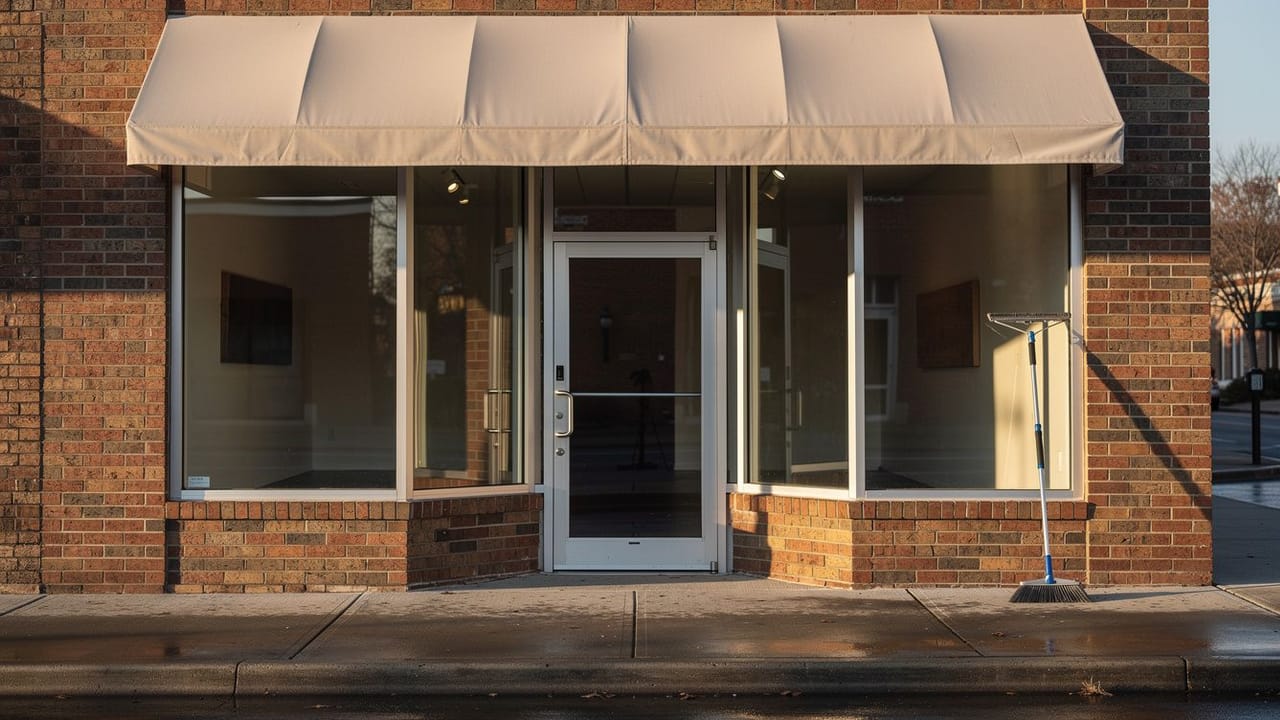
A house gets its windows cleaned when the owner notices them. A storefront cannot wait that long, because its glass is the first thing a customer looks through and the entrance door is handled all day. That is why commercial window cleaning runs on a schedule: the same building, the same scope, on a set day, done before the doors open or after they close. This is how our crews set that schedule, what a commercial visit covers, which glass gets a pole and which gets a ladder, and where the federal fall rules come in. The details of the service itself are on our storefront and commercial glass page.
What sets the interval for a storefront
In our experience, three things decide how fast a storefront gets dirty, and none of them is the calendar. Foot traffic is the first: the entrance door and the glass beside it collect handprints, nose prints from children and dogs, and a haze at the height where people lean to read the hours. A shop with a steady stream of customers needs that door done far more often than its upper windows. The second is the awning. Glass under an awning stays out of the rain, which sounds like an advantage until you see that nothing rinses it either, and the drip line at the awning’s edge leaves a row of spots along the top of the pane.
The third is the road. Glass a few feet from a busy street picks up a gray film from passing traffic, heavier in winter when the roads are treated and in summer when dust blows off construction sites. Construction next door changes the schedule outright: the glass industry’s cleaning bulletin, GANA 01-0300, warns that concrete or mortar slurry on glass is especially damaging and should be washed off as soon as possible.
We do not quote one interval for every building, because no general one has a primary source behind it. The only written interval we know of is narrow: Viracon’s glass cleaning and maintenance recommendations call for cleaning its first-surface etched or enamel glass every six months, or more often in harsher soiling environments. For ordinary storefront glass we walk the building, see where the dirt lands, and set the entrance, the street-side glass and the upper windows on their own rhythms.
What a commercial visit covers
A clean storefront pane in a dirty aluminum frame still looks neglected, so the frames and mullions get wiped on every visit, and the sills are cleared of the grit and insects that collect against the glass. Sliding doors on offices and patios get their tracks vacuumed and wiped, since grit in a track wears the rollers and drags the door. The entrance gets the most attention: both faces of the door glass, the push plate and handle area around it, and the sidelights.
Glass that carries the business’s name needs care. Vinyl lettering and hours decals are cleaned around and over with a soft touch, never scraped, because a blade catches the edge of the vinyl and lifts it. Inside an office, the scope often extends to glass partitions, conference room walls and interior doors, which collect fingerprints the same way the front door does. The GANA bulletin is plain that architectural glass has to be cleaned as part of routine maintenance and can be permanently damaged if it is cleaned improperly, which is why the scope and the method are written down before the first visit.
- Storefront glass, outside on every visit and inside as agreed
- Frames, mullions and sills wiped
- Entrance doors and sidelights, both faces
- Sliding door tracks vacuumed and wiped
- Signage and decal glass, cleaned around the vinyl by hand
- Interior partitions and office glass where included
Water-fed pole or ladder, and the rules for height
Most upper storefront glass, transoms above the awning and second-floor office windows are cleaned from the sidewalk with a water-fed pole. Unger, which makes the equipment, describes cleaning with pure water: a resin filter turns tap water into spot-free pure water, the glass dries naturally, and a built-in meter for total dissolved solids shows when the resin needs replacing. For a business that means no ladder planted on a sidewalk customers are walking on, and no squeegee line on the glass above the door.
Ladders and hand squeegees still have their place: on entrance doors, at eye-level glass where a hand finish shows, inside the building, and on frames a brush cannot reach. Above that, the federal rules set the line. OSHA’s duty to have fall protection, 29 CFR 1910.28, requires a guardrail, safety net or personal fall protection for a worker on a surface with an unprotected side or edge 4 feet or more above a lower level, which covers a canopy roof or a second-floor ledge. A worker on a rope descent system 4 feet or more up must also be on a personal fall arrest system.
Rope descent work starts with the building owner. Under 29 CFR 1910.27, before a rope descent system is used, the owner must tell the employer in writing that each anchorage has been identified, tested, certified and maintained to support at least 5,000 pounds in any direction for each worker attached. A property manager asking for quotes on taller glass should have that paperwork ready. Glass beyond a pole’s reach is covered on our high and difficult access page.
Working around open hours, and what mineral spots mean
Most of our commercial routes in Nashville and the surrounding towns run early, so the street-side glass and the entrance are done before the first customer arrives. Offices often prefer the inside glass after hours or on a weekend, when desks are empty and nobody has to move a chair. Pole work can go on with the doors open, because the glass dries without wiping, but the runoff is directed away from the entrance so no one walks in across a wet threshold.
Shopping centers in Middle Tennessee have their own problem: irrigation heads in the landscape beds that throw water onto the lower panes every morning. The hard water leaves a white crust that ordinary cleaning moves around without lifting. Viracon’s guidance is that its architectural glass needs routine cleaning to keep mineral deposits and airborne contaminants from building up, and that alkaline concrete and mortar slurry will eventually etch the glass surface. Spots that have been left long enough need a separate treatment, covered on our hard water stain removal page, and the fix that lasts is turning the sprinkler heads away from the glass.
Sources
- Viracon, Glass Cleaning and Maintenance Recommendations (2.3-7989) — Routine cleaning to prevent mineral deposits; alkaline slurry etches glass; six-month interval for first-surface etched or enamel glass
- GANA Glass Informational Bulletin 01-0300, Proper Procedures for Cleaning Architectural Glass Products — Glass cleaned as routine maintenance; improper cleaning can damage it permanently; wash off concrete or mortar slurry as soon as possible
- OSHA, 29 CFR 1910.28, Duty to have fall protection — Fall protection at 4 feet; personal fall arrest on rope descent systems
- OSHA, 29 CFR 1910.27, Scaffolds and rope descent systems — Building owner’s written anchorage certification, 5,000 pounds per attached worker
- Unger, Cleaning with Pure Water — Resin filter purifies tap water; glass dries naturally; TDS meter shows when to replace resin