
· by Michael Blair, Nashville's Window Cleaning
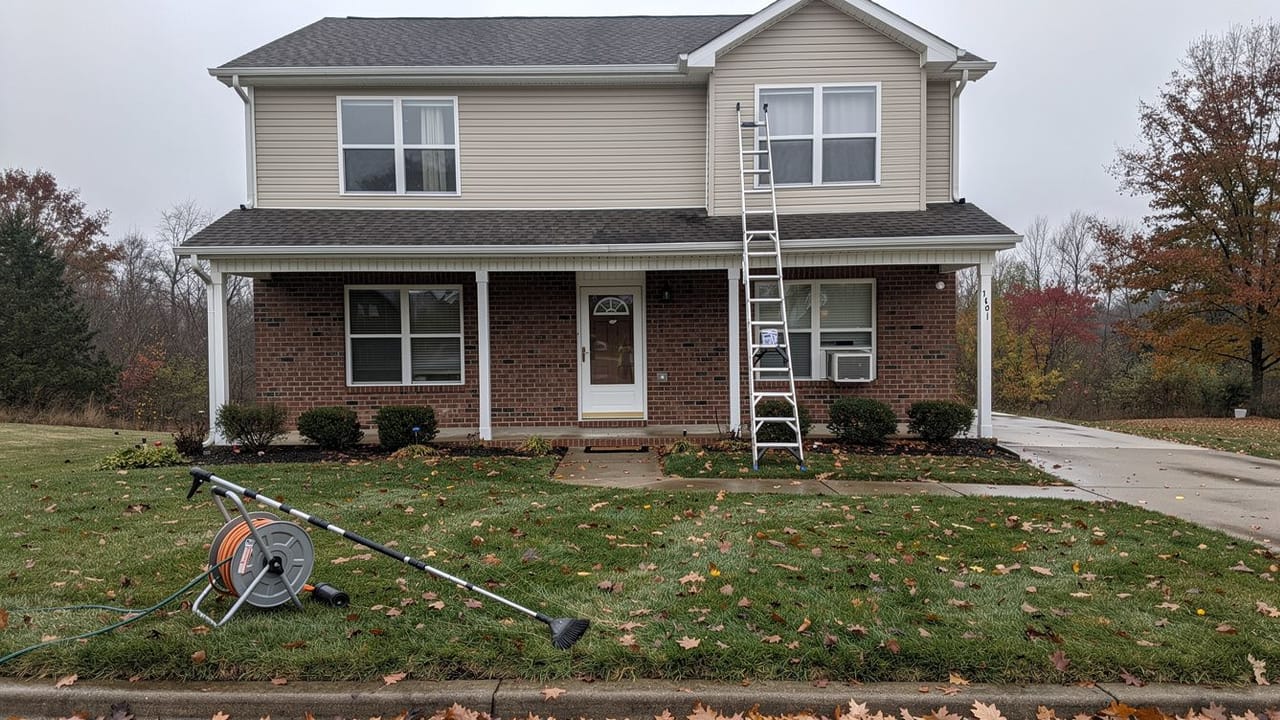
Most window cleaning on a Middle Tennessee house happens off the ground. The second-story glass on a brick two-story in a Williamson or Davidson County subdivision is reached with a water-fed pole from the lawn, an extension ladder, or a step out onto the porch roof to get at the dormers. That is why “insured” is a fair thing to ask a window company about, and why the useful answer is more specific than yes. This is what the word should cover for window work, how to check it in Tennessee instead of taking it on trust, and what changes when the glass is on a taller building. What we clean on houses, inside and out, is on our residential window cleaning page.
What can go wrong on a window job at a house
Window cleaning looks like light work until you list where it happens. An extension ladder stands on lawn or mulch beside the foundation, and after a wet week the clay under the grass gives way unevenly, so one foot sinks and the ladder twists. A ladder rested on a gutter instead of the wall bends the gutter and can slide sideways along it. A crew member stepping onto a porch or bay window roof to reach a dormer is now standing on shingles that may be wet with dew, above a drop that does not look like much from the driveway. Inside, a ladder or a bucket near a window sill can scuff a floor or knock into furniture.
A water-fed pole takes most of that off the table, which is why it does the bulk of the upper glass on houses. A brush on a telescoping pole, fed with purified water, scrubs and rinses second-story windows while the worker stays on the ground. It has its own risks, though smaller ones: a long pole swung near the service drop or a tree limb, runoff left on a deck, a brush head that clips a light fixture. Glass the pole cannot reach well, such as a stairwell window over a slope or a transom above a two-story foyer, goes back to ladders, and that work is covered on our high and difficult access page.
So two different things can go wrong. Someone can get hurt, and something of yours can get damaged. Those are answered by two different kinds of insurance, and a company that says “we’re insured” may only mean one of them.
Workers’ compensation and the small window crew
Workers’ compensation is the coverage that pays when a worker is injured on the job. In Tennessee, whether a window cleaning company has to carry it depends on its size. The state Bureau of Workers’ Compensation’s page on who must carry insurance outside construction sets the line at five or more employees. Part-time workers, minors and family members who work in the business all count toward the five. The owners of a sole proprietorship, an LLC or a partnership do not.
That matters in this trade, because a lot of window cleaning is done by small crews: an owner and one or two helpers, sometimes more in spring when pollen season fills the schedule. A company that size can be operating within the law without workers’ compensation at all. It is a question to ask directly rather than assume, especially for a two-story job where someone will be on a ladder for most of a morning.
The other thing to listen for is how the helpers are paid. The same state page says employee status is decided by a seven-factor test, with the most weight on who controls how the work is done, and that paying someone on a 1099 does not by itself make them an independent contractor. A crew member who shows up in the company’s van, uses the company’s poles and ladders and cleans the way the owner tells him to looks like an employee under that test, whatever the paperwork says.
Damage to the house is a separate policy, usually called general liability. Ask what it covers for window work specifically, such as a ladder through a screen or a pole against siding, and whose name is on it.
Checking coverage instead of taking it on trust
Window cleaning is often a recurring service, set up once and then repeated in spring and fall, or monthly for a storefront. That makes the timing of any proof matter. The Tennessee Department of Commerce and Insurance’s workers’ compensation insurance information page notes that someone holding a certificate of insurance may not be told when the coverage is canceled or not renewed. A certificate handed over at the first visit two years ago says nothing about the crew on your lawn this week.
The same page points to a better check. The Bureau of Workers’ Compensation runs a Coverage Verification tool, listed under Available Resources on the Division of Workers’ Compensation home page, that shows whether an employer has a valid policy. It takes a few minutes and can be repeated whenever the schedule comes around again. The Bureau also answers questions at 800-332-2667.
For property managers and builders, the same Commerce and Insurance page explains why this is more than a formality. It cites Tenn. Code Ann. § 50-6-113, under which a principal contractor, intermediate contractor or subcontractor can be liable for compensation to any worker on the job, and the next contractor up the line with valid coverage can be charged for an uninsured worker’s injury. A general contractor who brings in a window crew for the final clean on a new house, the work on our post-construction glass page, is exactly that next contractor up.
Taller glass, rope work and the building owner’s part
Houses are ladder and pole work. Office buildings, apartment blocks and mid-rise towers are where window cleaning goes over the side on ropes, and the federal rule for that starts before the crew arrives. OSHA’s standard for scaffolds and rope descent systems, 29 CFR 1910.27, says that before a rope descent system is used, the building owner must give the employer written confirmation that each roof anchorage has been identified, tested, certified and maintained to hold at least 5,000 pounds in any direction for each worker attached. That confirmation rests on an annual inspection by a qualified person and a certification at least every ten years, and the employer may not let anyone use an anchorage without it.
The same standard requires that each worker on a rope descent system be trained, that the equipment be inspected at the start of each shift, that each worker also be tied to a separate, independent personal fall arrest system, and that the system not be used in hazardous weather such as storms or excessive wind. A property manager getting quotes for that kind of building should have the anchorage paperwork ready and expect a crew to ask for it. A window company that does not ask is telling you something. How we schedule storefront and office glass is on our commercial glass page, and the reasons a homeowner might stop doing their own upper windows are in our post on when to stop cleaning your own windows.
Whatever the building, the questions are the same short list. Ask them before anyone sets up a ladder, and if you want our answers for your house or building in Franklin or anywhere else we work, ask for an estimate and put the questions in the message.
- Do you carry workers’ compensation, and if not, how many people work for you?
- Are the people on the ladders your employees, and who directs their work?
- What does your liability policy cover for damage to the house: screens, siding, gutters, floors?
- Which windows will you clean from the ground with a pole, and which need a ladder or the roof?
- For rope work: have you received the building owner’s anchorage certification?
Sources
- Tennessee Bureau of Workers’ Compensation: Who Must Carry Insurance? (Non-Construction) — The five-employee threshold outside construction, who counts toward it, and the seven-factor employee test.
- Tennessee Department of Commerce and Insurance: Workers Compensation Insurance Information — Certificate holders may not be notified of cancellation; the Coverage Verification tool; Tenn. Code Ann. § 50-6-113 on contractor liability.
- OSHA 29 CFR 1910.27: Scaffolds and rope descent systems — Building owner’s written anchorage certification, 5,000-pound capacity, inspection and certification intervals, independent fall arrest and weather limits.