
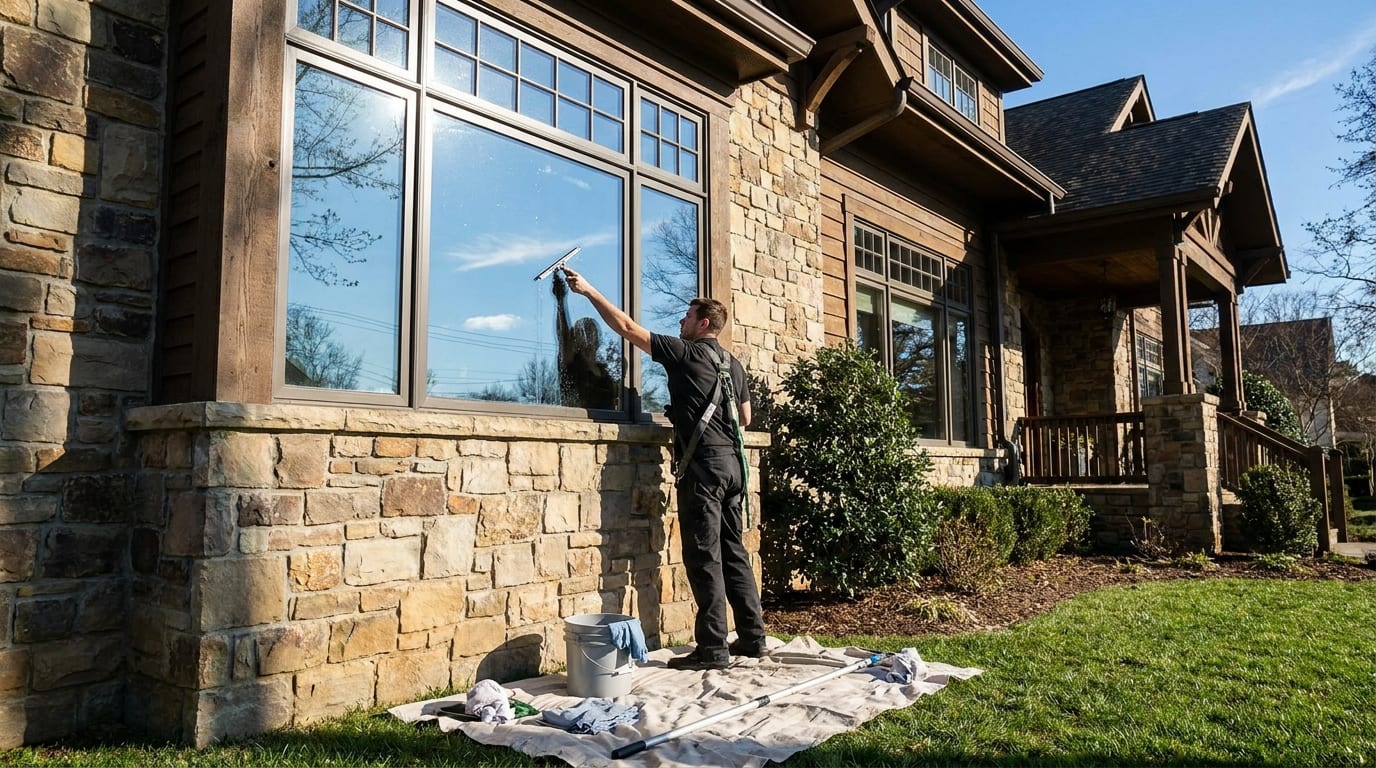
· by Michael Blair, Nashville's Window Cleaning
Middle Tennessee water leaves calcium behind as it evaporates. On glass that becomes a bonded deposit that detergent does not touch, and left long enough it etches the surface permanently.
What is the difference between deposit and etching?
Deposit sits on the surface and comes off with acid and dwell time. Etching is the glass itself having been attacked, and it cannot be cleaned off.
The test is simple: if a descaler applied and left improves it, it is deposit. If nothing changes, it is etched.
How do you remove hard water deposits from glass?
An acidic descaler — citric, acetic or a purpose-made product — applied and left to dwell, then agitated with a non-scratch pad and rinsed.
It usually needs repeating on heavy build-up. Dwell time does more than scrubbing pressure, which risks scratching.
- Acid descaler with real dwell time, not more scrubbing
- Non-scratch pad only
- Repeat rather than increase pressure
- Protect frames and seals from the acid
- Squeegee after every shower to prevent recurrence
Etched glass
Professional polishing with cerium oxide can improve light etching. Deep etching is not recoverable and the panel needs replacing.
That is the argument for dealing with spotting early rather than living with it for years.
Preventing it
On shower glass, a squeegee after each use is by far the most effective habit — scale forms as water evaporates, so removing the water removes the mechanism.
On windows, redirect any sprinkler hitting the glass. A water softener addresses the source across the house.
FAQ
Removing Hard Water Spots From Glass — questions
Can hard water spots be removed permanently?
The deposit can, with acid and dwell time. What cannot be removed is etching, where the deposit has been present long enough to attack the glass itself. Light etching sometimes improves with professional polishing; deep etching means replacing the panel.
What is the best product for water spots on shower glass?
An acidic descaler based on citric or acetic acid, applied and left to dwell rather than scrubbed hard. Dwell time does the work; pressure risks scratching. Heavy build-up usually needs two or three applications rather than one aggressive one.
How do I stop shower glass spotting again?
Squeegee it after every use. Scale forms as water evaporates on the surface, so removing the water removes the mechanism entirely. It takes a few seconds and it is far more effective than any coating or cleaner, particularly in Middle Tennessee water.
Why do hard water spots keep coming back on my windows?
Because whatever wets the glass is still wetting it. Removing the deposit with a descaler only resets the pane, and a sprinkler head throwing water on it lays down fresh calcium every time it runs. Turning that head away from the glass stops the spotting, and a water softener deals with the hard water at its source across the house.